Case Study: The Global Fund Data Explorer
Conceptualisation, creation and development of a flagship transparency platform
The Challenge
The Global Fund raises and invests billions of dollars a year from donor governments, the private sector and civil society to fight three of the world's deadliest diseases. With that scale of investment comes a fundamental obligation: donors, implementers and the public need to see, clearly and credibly, what the money is achieving.
Before 2016, the organisation's results and financial data lived across disconnected reports, spreadsheets and PDFs — accurate, but not accessible. Communicating impact meant static documents that went stale the moment they were published, and donor countries had no easy way to interrogate the numbers behind the narrative.
The brief, as I saw it: build a tool that turned the Global Fund's results and grant data into something people could actually explore — not just read about.
The Idea
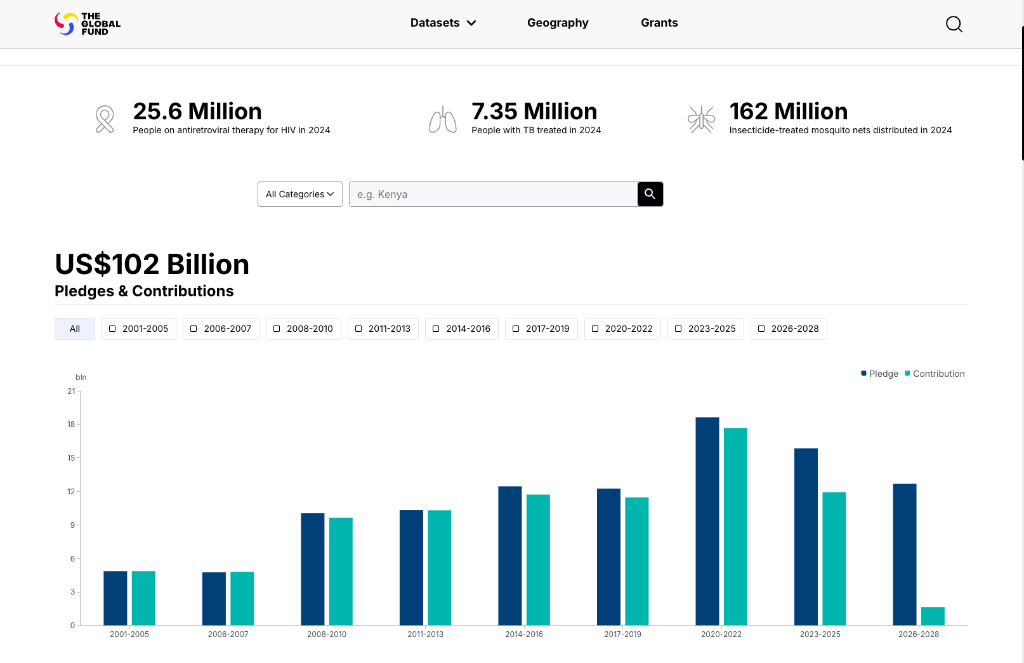
I conceived of the Global Fund Data Explorer as a public-facing, interactive platform that would let anyone — a donor government official, a journalist, an implementing partner, an interested citizen — query the same underlying data the organisation used internally, and see it visualised instantly by country, disease, grant, time period or funding source.
The core principle was transparency through self-service: instead of the Global Fund telling people what the data meant, the data would be put directly into their hands, with the visual and narrative tools to make sense of it themselves.
What I Built
I led the conceptualisation and end-to-end development of the platform, which became data.theglobalfund.org, covering:
- Data architecture — consolidating results, financial and grant data from multiple internal systems into a single structure that could power live, filterable visualisations
- Interactive data visualisation — dashboards allowing users to slice results (HIV, TB and malaria programme data) and investment figures by country, region, grant and time period
- Design and user experience — an interface built for non-specialist audiences, including donor delegations and the media, prioritising clarity over complexity
- Content and narrative layer — framing the data with the context needed to interpret it correctly, so numbers were never presented without meaning
- Stakeholder alignment — working across data, communications, and donor relations teams to ensure the platform served accountability needs on both sides: the Global Fund's obligation to report, and donors' need to verify
Impact
The Data Explorer became a standing reference point for how the Global Fund communicated progress against its strategic goals, and a practical accountability tool for the donor governments and boards who needed to see where — and how effectively — their contributions were being deployed. It shifted the organisation's transparency posture from periodic reporting to continuous, self-service access to the same data used internally.
The platform's underlying approach — connecting data sources into a single integrated stack and turning them into interactive stories — went on to directly inform DataXplorer, the data platform I later founded, which continues to operate in parallel with and alongside the Global Fund's own data explorer today.
John Busch conceptualised, created and led development of the Global Fund Data Explorer during his nineteen years at the Global Fund. He now advises organisations on digital strategy and data-driven communications through John Busch Consultancy.