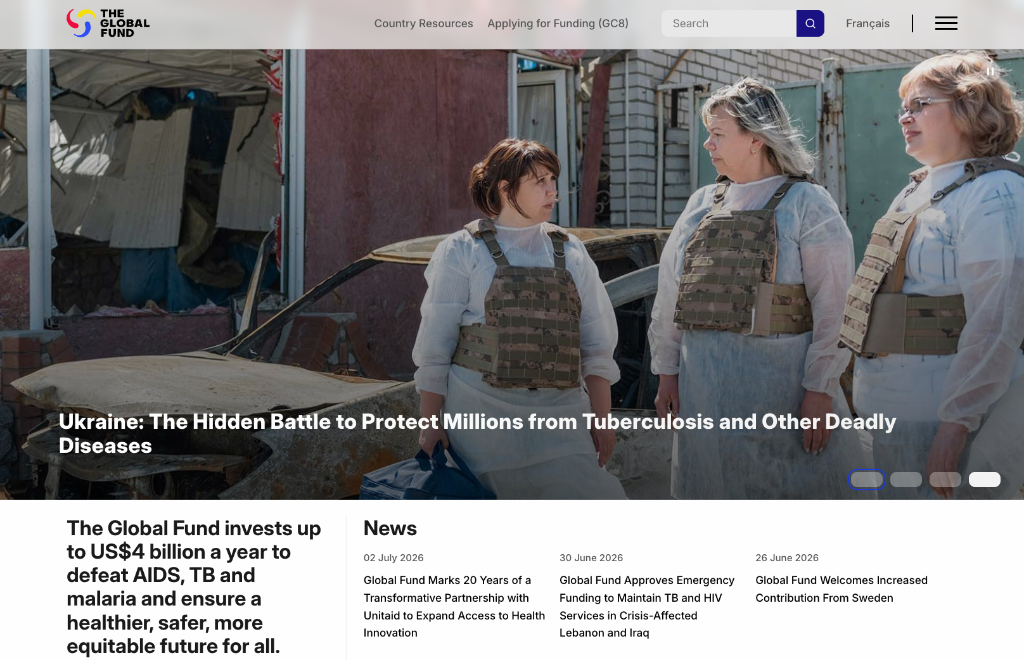
Case Study: The Global Fund Website
A multilingual, data-driven platform for global health accountability
The Challenge
The Global Fund to Fight AIDS, Tuberculosis and Malaria was founded in 2002 to raise and invest billions of dollars a year from donor governments, the private sector and civil society. From its earliest months, it faced a challenge few global health institutions had solved before: how to make that scale of financial and programmatic activity — thousands of grants, spanning every country where the three diseases take their toll — genuinely visible to the people funding and relying on it, in real time, in their own language.
A conventional corporate website, built around static reporting, wouldn't do it. The site had to carry the organisation's founding promise of transparency: anyone, anywhere, should be able to see exactly where the money was going and what it was achieving.
The Platform
theglobalfund.org was built around a simple principle: the site itself should function as a transparency instrument, not just a communications channel. At its centre sat an online grant portfolio — a genuinely novel feature at the time — that connected financial and programmatic data directly to the public-facing site, letting a donor government official, journalist or member of the public trace an investment through to results without needing to request a report.
The site launched in six official UN languages from the start, reflecting the global, multi-stakeholder nature of the Global Fund's donor base and the countries it served. An accompanying intranet supported the organisation's own rapidly growing internal communications needs.
Over the following two decades, the platform evolved continuously rather than being rebuilt from scratch: re-architected repeatedly to keep pace with the Global Fund's expanding grant portfolio, growing board and donor expectations, and the broader shift across global health and development toward open data. Its scope grew from a website into a full digital ecosystem — web, data and mobile platforms, content management and web analytics, social media and e-marketing — all oriented around the same founding goal of public accountability.
Development Timeline
- 2002–2004 — Earliest web presence built in the organisation's first two years, developed by a small WHO/UNAIDS/Global Fund consultancy team alongside related platforms for UNAIDS and the Global Coalition on Women and AIDS.
- 2004–2006 — The site was designed, programmed and authored from the ground up in six UN languages, centred on the online grant portfolio that made financial and programmatic data on the fight against HIV, TB and malaria publicly navigable for the first time. The Global Fund's intranet was built in parallel, and a dedicated web team was formed.
- 2007–2009 — The platform entered a phase of structured technical and creative growth, with coordinated content and publishing management extended across all Global Fund web properties, including digital support for the organisation's bi-annual Executive Board meetings worldwide.
- 2009–2015 — Web and intranet strategy matured alongside the organisation's broader corporate communications, with digital brand and asset development extended through partnerships with UN agencies, GAVI, Unitaid and the Bill & Melinda Gates Foundation.
- 2015 onward — The platform expanded into a full digital space spanning web, data and mobile, led by a multidisciplinary team of designers, UX specialists, writers and developers, with public digital and data communication positioned as a strategic tool for accountability and transparency in global health financing.
Impact
theglobalfund.org became, and remained, the organisation's primary public accountability platform for two decades — the place where its founding promise of transparency was made tangible, in six languages, to donor governments, implementing partners, journalists and the public. It set a benchmark for how a global health institution could combine multilingual reach with granular, drillable financial and results data, and its underlying philosophy — that data should be put directly into people's hands — went on to shape the Global Fund Data Explorer and, later, DataXplorer.
John Busch designed, built and led the development of theglobalfund.org across successive roles from 2002 — months after the Global Fund's founding — to 2022, culminating in senior digital leadership of the organisation's full web, data and mobile platform strategy. He now advises organisations on digital strategy and data-driven communications through John Busch Consultancy.